
Images are for illustration only. Actual product may vary.
Matching cards
Before words, before letters, there is the question: which one is the same?
- Your child is at the stage before sorting and categorising
- They look at two things but don't yet judge same/different reliably
- You want pre-academic practice that doesn't feel like academics
- Therapy is working on visual discrimination and you need home cards
- They learn best through hands-on play, not pointing at a screen
The idea behind it
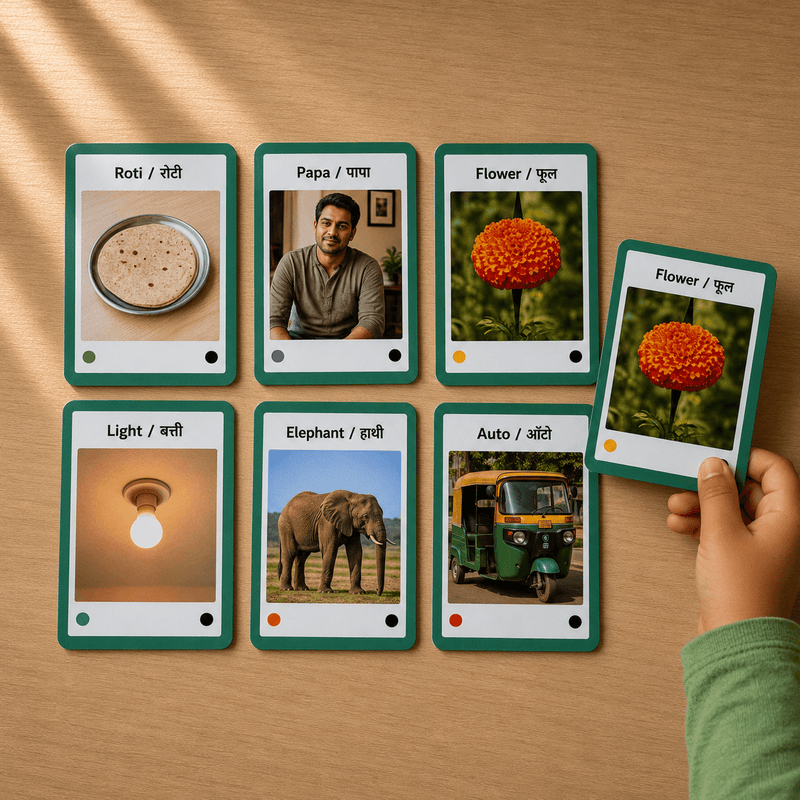
This deck has thirty pairs of identical Indian-context objects — steel glass, tiffin box, chappal, autorickshaw, banana, kite, mango — sixty cards in total. Your child finds the match. Match card-to-card on the floor, or match card-to-real-object from your kitchen. Both work. Both build the same skill.
Designed with our OT panel. Mapped to ARIS lessons 12–14 — 3D-to-3D, 3D-to-2D, and identical matching of common objects.
Best for
Children at developmental age 2–5 building visual discrimination — the foundation for sorting, reading, and maths.
What's inside
How to use it at home
Match two pairs
Pull just four cards — two pairs. Spread them face-up. Show your child: "These are the same. Find the same." Help their hand if they need it. Two pairs is the entire game for the first week. Mastery before expansion.
Build up to six pairs
Add a new pair every two days. By the end of week two, your child should be matching six pairs face-up. Switch from "find the same" to "where is the match?" — the question shifts from instruction to invitation.
Match cards to real objects
Take a card — steel glass — and walk to the kitchen. Find a real steel glass. Place the card next to it. That jump from picture to real object is the moment matching becomes a thinking skill, not a memory game.
Reviews
Every product is designed with occupational therapists
Our clinical panel works with Indian children every day. Every product is reviewed for safety, developmental fit, and how well it works in a real home — not just a clinic. If your child's OT recommends something different, listen to them first. We're a tool, not a substitute for therapy.
Take the 5-minute Readiness Check
17 questions across 6 areas. At the end, you'll get a personalised list of which tools are right for your child today — and which to wait on.